
DEMO
Of Words and Magic
The players take on the role of magically gifted champions who, with the help of the chaos god Urgon, try to bring the magical language back to the mortal world. To do this, they climb the Tower of Babel again and again in a Rouge Like Deckbuilder to finally defeat the Goddess of Harmony. However, since the magic language is lost, the champions must guess the correct words to use the magic. The god of chaos will help you with this.
The concept and the demo was developed in the context of my bachelor thesis. The goal was to develop a vocabulary learning game that helps users to store vocabulary in their long-term memory in a fun and motivating way.
- Unique approach that combines vocabulary learning with motivational Rouge Like Deckbuilding elements.
- Diverse cards and champions for different play styles.
- Constant rewards, new unlockable characters, skills, spells and monsters provide motivation.
- Practical learning approach that unerringly brings vocabulary into the long-term memory.
Game World
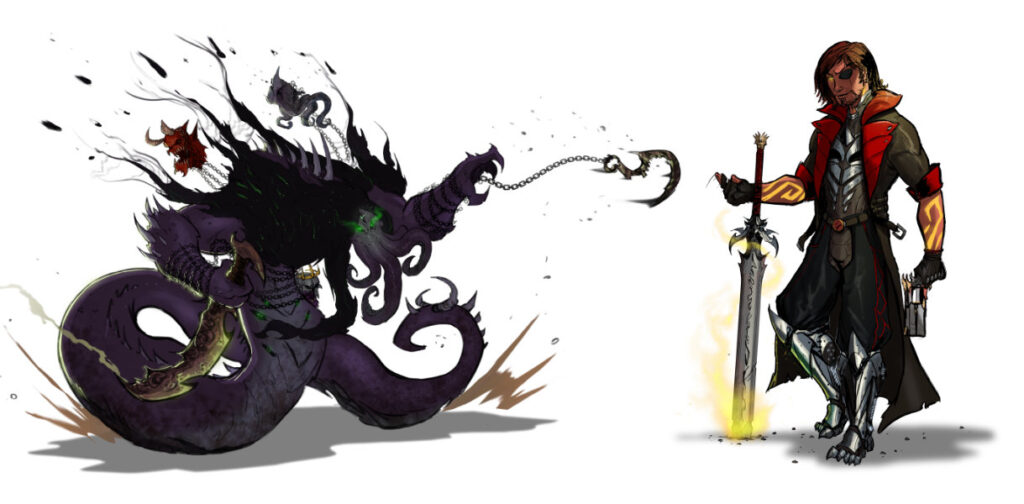
Mitgard is a diverse world full of magic and different languages and amazing creatures. The powerful Mages Guild in the capital city of Babel, rules the land and helps the citizens of Mitgard through summoned workers, weather spells and healing. But magic also has its dark side, ambitious spellcasters fight each other ruthlessly with summoned creatures. They scheme against each other and try to claim as much territory as possible for themselves. To use magic, the spellcasters use a secret magical language to control mana. One day, when the Goddess of Harmony looks upon Mitgard, she is so shaken by the chaos that reigns there that she begins to weep. Rain falls on the land and unites all creatures in a common language. However, the inhabitants of Mitgard and especially the Mages Guild are not happy about this at all, because they have also lost the language with which they can control mana. The god of chaos Urgon is also not happy about the new harmony in the land, which is why he appears to especially gifted magicians and makes them his champions. He helps them to use magic and with his help they gradually learn more of the magical language. To bring back the magical language the mages guild gathers the best architects of the land to build a tower up to heaven. One of the champions must climb this tower with the help of Urgon to defeat the Goddess of Harmony and lift her „blessing“. Little by little, the different languages return to the people.
Gameplay
The game is a rouge like deck builder. The players choose a champion with different abilities and a standard deck of cards. Then they enter the Tower of Babel. On each floor, players will find a room to improve their deck or an opponent to defeat. Fighting is done with monsters and spells represented by cards. Each summon or spell costs a certain amount of mana. To control the mana and strengthen the summon or spell, the language of Magic must be used correctly – meaning a random word has to be translated correctly. Once the opponent is defeated, the players receive gold and experience. Gold they can spend on improvements to their deck on certain floors in the further run. At the end of the tower, a powerful final boss must be defeated. If the players are defeated, they start again on the 1st floor in the next run and lose the cards and gold they acquired in the tower. However, with the experience points they can unlock more champions, spells or monster cards and other buffs before the next run, which will make their next attempt easier. The final boss they will face is the Goddess of Harmony.
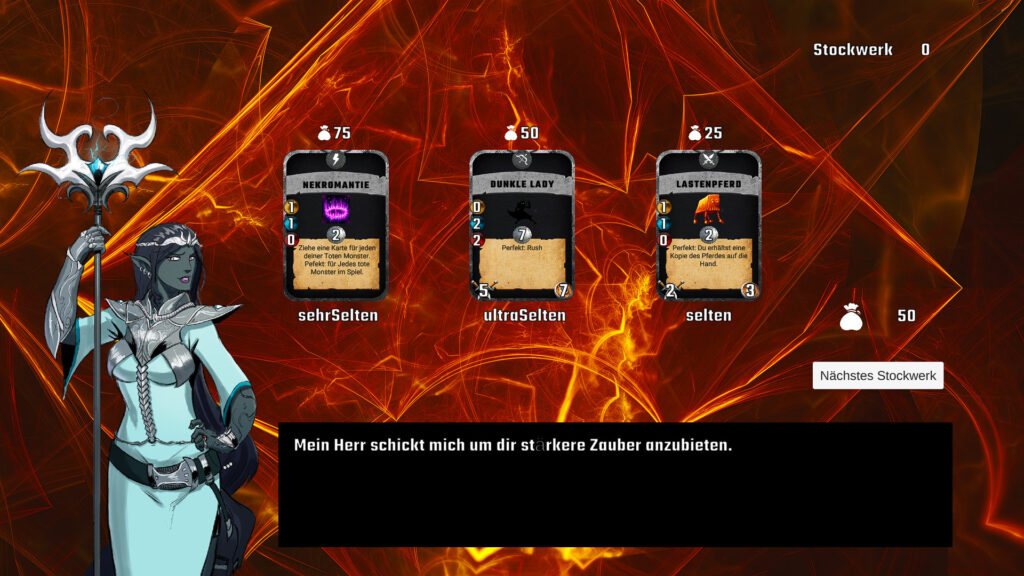
Discovering new areas and defeating bosses unlocks cards that can then be purchased in the store and used in the game.
After each run, a number of card packs are given away to the players, measured by the amount of memory dust collected.
If one of the bosses is defeated, the Tower of Babel collapses, the players receive a large reward and the next difficulty level is unlocked. The world also changes. The inhabitants of Mitgard get their different languages back and more chaos ensues. New NPC’s become available and offer new gameplay options.
These mechanics keep players in a reward spiral, chasing the next boss and continuously improving their cards, decks, and options to become stronger. This Positive Feedback Loop is mitigated after overcoming a boss, in that the challenges also increase with each difficulty level, of which there are five.
Each level of difficulty increases the following:
- The difficulty level of the opponents.
- Winning gold by defeating an opponent.
- The memory dust gained.
- The probability with which rare cards are available in the store.
The game is divided into two areas. The Mage’s Guild, where players can customize their decks and make other purchases, and the Tower of Babel. When they enter the Tower of Babel they start a „run“ and work their way up the tower floor by floor, building their deck and fighting enemies. Once they have defeated the boss at the top of the tower, or have been defeated themselves, they return to the Mage’s Guild.
Mage Guild
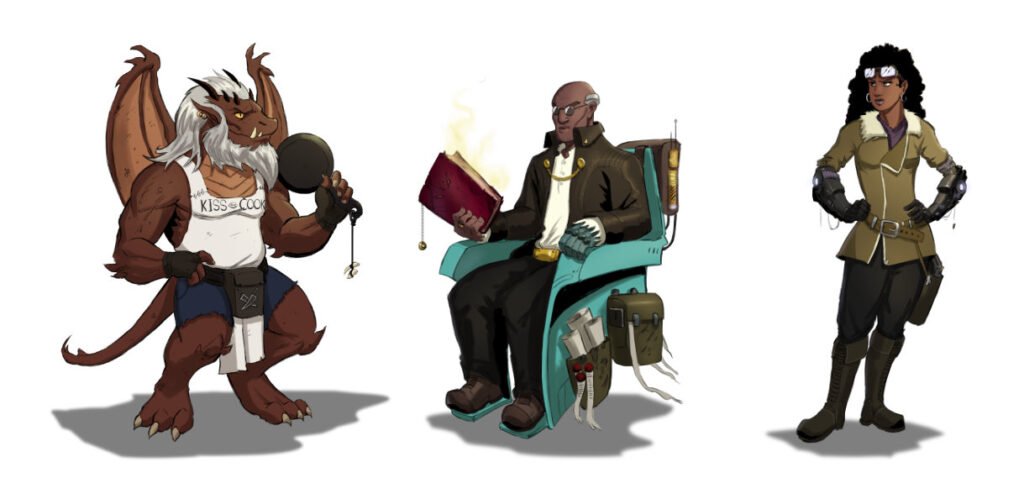
Here the players can do various things between runs in the Tower of Babel. Buy items and cards edit your champions and their lessons. It works like a living, interactive main menu. Visiting here, the players can customize the Altar of the Chaos God, the Quartermaster, the Architect and the Librarian and their deck of cards, change their champions, upgrade the tower and manage their vocabularies.
Tower of Babel
Between the battles, or other actions, the players see a map of the tower. They must choose which staircase they want to take to the next floor. The map is randomly generated and on each floor 1 – 3 stairs can be chosen. The players can see what action is waiting for them on the next floor by a symbol.
- Opponent - Must be fought and defeated.
- Store - cards can be added to the deck.
- Forge - A card can be improved by sacrificing another.
- Altar - Heilung gegen Gold.
- Boss opponent - Strong opponent with high reward.
Combat
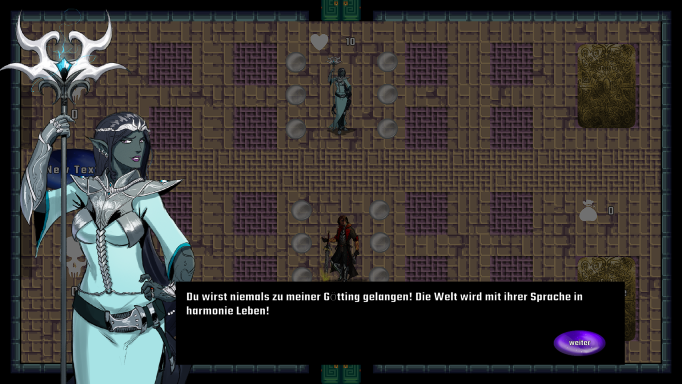
If the players encounter an opponent, they must be defeated. A battle is won when the opponent’s life points have dropped to 0. The battle is lost when the player’s own life points have dropped to 0. The players start each run with 100 life points. The players can only heal themselves at certain places in the Tower of Babel. The enemies have different life points from 10 to 50. The battles take place in rounds. Each round consists of the phases „Mana Phase“ „Spell Phase“ „Battle Phase“. After each round, it is the opponent’s turn. At the beginning, each side draws 8 cards. The battles make up the largest part of the game.
Mana-Phase
Players draw a card from their deck at the beginning of the Mana Phase. The players get another mana unlocked every turn, up to a maximum of 6 mana. They can change the 6 mana sources as they wish (red, yellow, blue). Each mana source can only be used once per round.
Spell-Phase
The players can place more cards as long as they have mana available. Monster cards can be placed in the appropriate row (melee/range). When mana is used up, a random word in the appropriate difficulty is retrieved from the database and must be translated using multiple choice. The words are asked in both directions, original to translation as well as vice versa. If the word was translated correctly, the reinforcing effect occurs. And the players get 5 gold. In this phase, the monsters‘ special abilities can also be used and spells can be played if there is enough mana for them.
Combat-Phase
In this phase, the monsters attack. The players can decide in which order and which opponent their summoned monsters should attack. Newly summoned monsters must wait one turn before they are allowed to attack. If there is no monster on the two summon slots opposite the monster in a straight line, the opponent is attacked directly.
The monster’s attack points are then subtracted from the attacked monster’s or opponent’s life points. If the monster’s attack is stronger than the defending monster’s life, the difference is subtracted from the opposing champion’s life points. If all monsters have attacked, the round is over and all of the attacking player’s mana sources are replenished.
Battleground
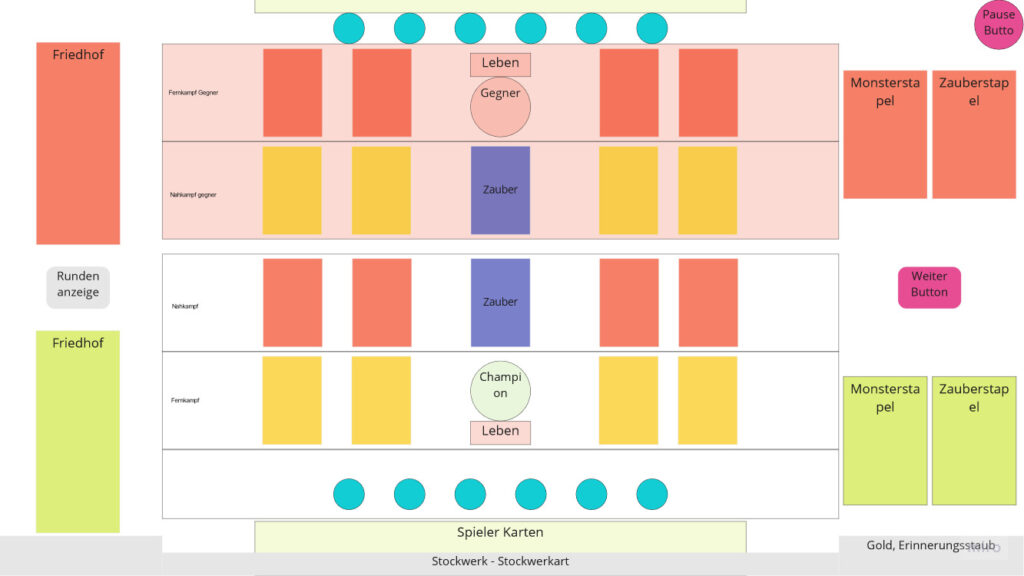
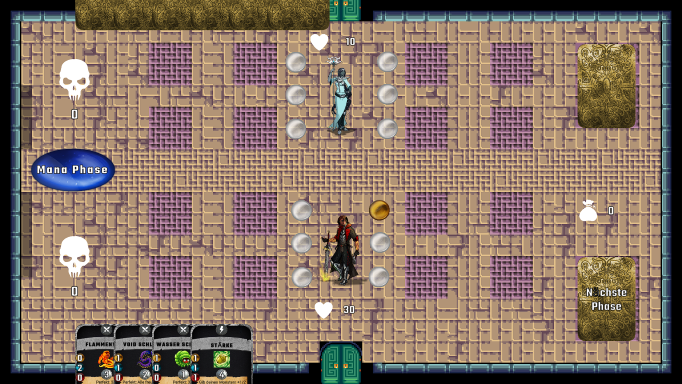
Each side of the board consists of two rows. Each side has six mana sources, which they can gradually change. In the second row four ranged units can be placed and in the first row four melee units. In the middle we find the character of the players. On the oposite side is the opponent. The opponent’s side of the board is a mirror image of the player’s side.
Cards
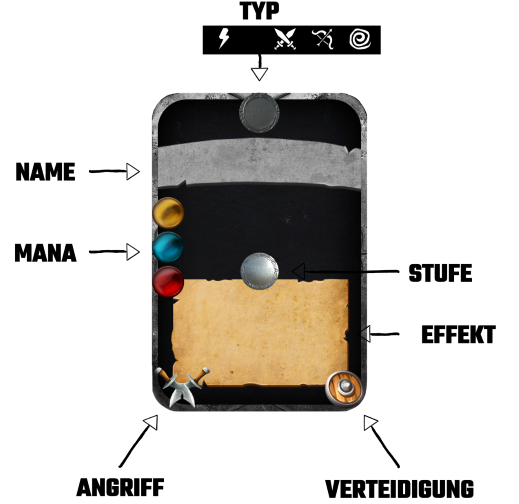
Cards are used to fight in this game, they either summon a monster or represent a spell. Each card costs a certain amount of mana and its effect can be amplified by translating words correctly. The cards are intended both as a flow-enhancing element, allowing players to develop their own play style, and as a reward or token system. They also put players in a positive feedback loop that gives them more and more options and better cards, making it easier to get to the boss fight even if they fail. The cards are worth different amounts and are divided into, rare, very rare and legendary. The rarer the card, the more expensive and stronger it is.
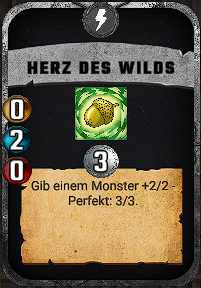
Monster Cards
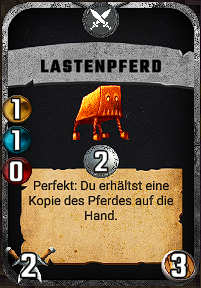
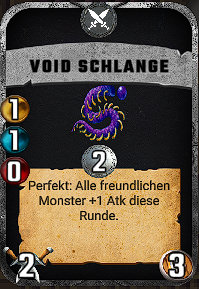
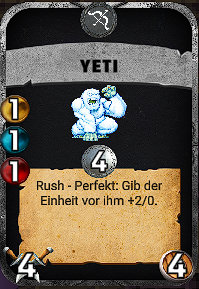
Each monster card has an attack power and life. It also has a special ability. The special ability is usually strengthened by a perfect summon.
Mana cost indicates what kind of mana is needed and how often.
Monster cards can attack the opponent or his monsters. However, after summoning, they are confused and must wait one turn until their first attack. Each monster also has a special ability that is usually triggered when it is summoned.
- Melee - Standing in the first row of the field. Melee fighters can only ever attack the nearest opposite monster.
- Ranged - Summoned in the back row of the field. Ranged monsters can attack opposite monsters in any row.
- Hybrid - When summoning, players can determine whether the monster should take on the characteristics of a ranged or melee monster.
Spell Cards
Spells influence the game once. The effect is usually amplified by a perfect incantation. Mana costs indicate what kind of mana is needed and how often.
Rewards und Economy
In order to establish a functional token system, an economic system must be established. These tokens are then used as reinforcers to motivate game players and reward desired behavior. As described in Behavioristic Learning Theorys, a reinforcer – i.e., the token – must be given as directly as possible after the action has been performed. For this purpose, the permanent currency memory dust is introduced, as is the currency gold, which is only available temporarily, i.e. in a run. Both currencies function as tokens and the cards that can be found and unlocked as loot.
Memory Dust
This currency remains with the players after the run. With memory dust they can unlock new spells and monster cards for the run. Spending memory dust gives them better chances in their further rounds in the Tower of Babel. And even if they lose in the tower, they become stronger and stronger due to this positive feedback loop. New characters must also be bought with it.
Reminder dust is earned by:
Erinnerungsstaub wird verdient durch:
- Use Mana Perfect (Means translate all words correctly) (Easy: 1, Medium: 2 , Hard: 3).
- Opponents (15) and bosses (100).
Gold
Gold is the currency used during the Tower of Babel run. With gold, players can temporarily strengthen their deck with additional cards during the run. Through this positive feedback loop, players become stronger the more they win. After the run, all gold collected is lost, this serves as an incentive for players to spend as much gold as possible during the run and not hoard it.
Gold is earned by:
- Translate a word correctly. (5 gold).
- Defeat enemies. (30 Gold)
Learning System
The players can create and manage a database with vocabulary and your translation. For an easy start, a basic vocabulary for different languages should also be offered. It would be ideal to work together with common textbooks, so that the vocabulary of a lesson can be automatically included in the database. The division into categories should help the players to better classify and structure the terms. The category is then displayed with the queried word. According to the cognitive learning theory, the division into categories should help to bring the vocabulary into a logical context.
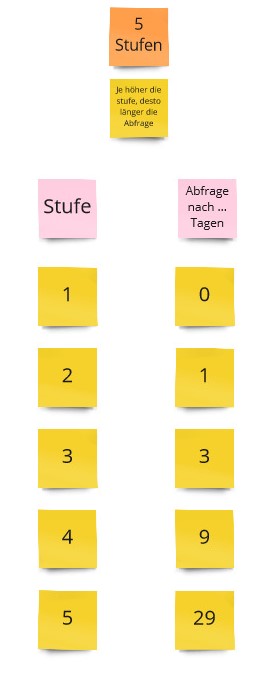
In order for the words to be reliably stored in long-term memory, they must be repeated regularly at different intervals. To increase the efficiency of the repetitions, we use a flashcard system. After 5 correct repetitions, the word is stored in the long-term memory. If a word is translated correctly, it moves up one level. If it is translated incorrectly, it moves down one level. Then the words are asked again after a certain number of days. If a vocabulary word is translated correctly at level 5, it is removed from the „card box“ and resides in long-term memory. For each level that a vocabulary goes up, the players get a higher reward in the form of memory dust. Once a vocabulary is in the long-term memory, there is an extra reward in the form of a pack of cards.
Mana
There are three different types of mana, red, blue and yellow. Each mana is controlled by words that vary in difficulty for the players.
Every summon and spell – almost every action – in the game costs mana. In order to control the mana perfectly, and to strengthen the effects, the displayed word must be translated correctly. It is important to mention here that the action is performed even if the word is translated incorrectly. However, the correct translation strengthens the monster or the executed spell, so memorizing the vocabulary is well worth it.
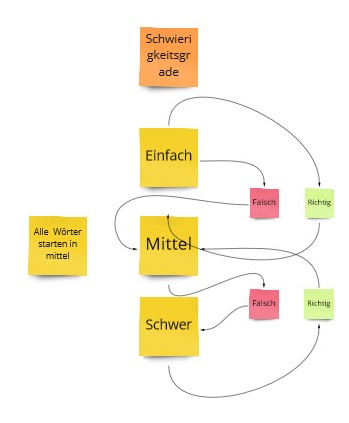
The words in the players‘ database are divided into the categories easy, medium and hard. Whereby all words are in the medium category at the beginning. If the words are translated correctly or incorrectly, they move to the other two categories.
Die Wörter in der Datenbank der Spielenden werden in die Kategorien leicht, mittel und schwer eingeteilt. Wobei alle Wörter zu Beginn in der Kategorie mittel sind. Werden die Wörter richtig oder falsch übersetzt, wandern sie in die jeweils anderen beiden Kategorien.
- Yellow Mana - Easy
- Blue Mana - Middle
- Red Mana - Hard
When used, a random word of the respective difficulty level is displayed, along with the category icon. A voice output of the word is also heard. The correct translation must be selected by multiple choice from a choice of three possible translations. If no word of the corresponding difficulty is available, a search is first made for one with a lower difficulty; if still none is found, a search is made for a higher difficulty.
According to behavioristic learning theory, operant conditioning must be followed as quickly as possible by a positive consequence in the form of a reinforcer. Therefore, if the answer is correct, a visual effect and positive audio feedback are given immediately, and a reward is also shown directly.
If the answer is incorrect, no punishment is given, a visual effect and audio feedback is given, and the correct answer is displayed.
Try it!
For a final game test, a prototype with the core gameplay elements was developed. The focus was on the vocabulary queries and the kinesthetic of the game.
Kontakt
-
Lukas Fritsch
12161 Berlin - gd@fritsch-lukas.de
Social Networks
Lukas Fritsch
Game Design
Portfolio